
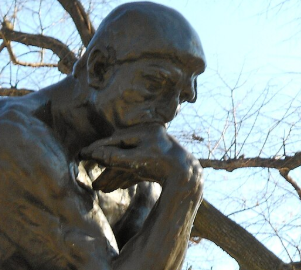
Deism is most often distinguished from religions and other worldviews by the limits it places on what can be believed. Unlike systems of belief that accept revelation of any form as a source of truth, Deism maintains that beliefs about reality, including beliefs about God, must be congruent with reason. This distinction is primarily epistemological. Epistemology is the branch of philosophy concerned with the justification of knowledge. The question is not what one ought to believe, but by what method one can establish that a belief is true. This article defends extreme rationalism, the idea that reason is the exclusive method by which propositions can be justified as true.
Standard well-formed propositions can be evaluated as either true or false based upon some criterion. Epistemology seeks to determine which criterion is correct for assessing propositions. There are several competing approaches. Empiricists maintain that propositions must be tested through experience and observation, while intuitionists believe that intuition is a special faculty through which truth can be recognized without further demonstration. Others appeal to mysticism, revelation, or dogmatic authority as sources of knowledge. Although these approaches differ in their methods, each attempts to establish a means by which ideas can be accepted as true. The problem is that none of these methods can independently establish the truth of a proposition. Only reason can determine whether an argument is logically valid, whether its premises are sound, and whether its conclusion necessarily follows.
A proof attempts to demonstrate that an idea is true. A disproof, or negative proof, attempts to demonstrate that an idea is false. In either case, the process requires sound premises and a valid deduction. A deduction is valid when its conclusion necessarily follows from its premises. For a proof to be sound, its premises must also be true. There are no substitutes for either requirement. An argument cannot establish the truth of its conclusion if the conclusion does not logically follow from its premises. Similarly, a valid deduction cannot establish a proposition as true in reality if its premises are false. Reason is not one method among many equal approaches for evaluating ideas. Reason is the necessary standard by which any proposed argument must ultimately be assessed.
The necessity of reason becomes clearer when distinguishing between a priori and empirical knowledge. A priori propositions are those whose justification does not depend upon experience or observation. Their truth can be established through reason alone, provided their premises are sound and their deductions are valid. For example, that a proposition cannot simultaneously be true and false in the same respect is grounded in the principles of logic rather than empirical observation. Such propositions can be demonstrated deductively and are not dependent upon the particular conditions of the material world.
On the other hand, empirical propositions depend upon premises derived from observation or experience. They may be reasonable to accept, but their truth remains contingent upon the accuracy of those premises. For example, the proposition that my neighbor's car is blue depends upon me seeing the car, and my senses being reliable. Reason can establish what follows from those premises, but it cannot make observations full-proof. Consequently, empirical conclusions can be contingently true, subject to the premises being correct and applicable. Experience may provide premises, but reason determines whether the conclusions drawn from them are warranted. Inductive empirical proofs are possible, but they cannot gain apodictic status in the same way as purely deductive arguments.
The necessity of reason can also be demonstrated by considering ideas that are internally inconsistent. For an idea to be proven, it must be logically understandable. If a proposition contradicts itself, it cannot be established as the truth because it violates the prerequisites for rational demonstration. Consider a proposition that asserts both that something exists and that it does not exist at the same time. These claims are mutually exclusive and cannot both be true. No appeal to experience, intuition, or mystical understanding can resolve this. The proposition must either be reformulated to remove the inconsistency or rejected. Even if one were to construct an argument from contradictory premises, such an argument would not constitute a sound proof. This demonstrates that logical consistency is not an optional requirement of knowledge but is a necessary condition for it.
The same reasoning applies to propositions founded upon impossible or contradictory premises. An argument may be logically structured and its conclusion may follow from its premises, yet that does not establish the conclusion as true if the premises themselves are impossible. For example, one could construct a valid argument that 5-2 = 2, if we take 2+2 = 5 as a premise. The conclusion would be dependent upon an impossible assumption. This distinction is important because validity and truth are not the same. A conclusion may follow logically from an assumption without the assumption itself being true. To establish a sound proof, one must demonstrate that the deduction is valid, and also that its premises are possible and true.
These considerations expose the weaknesses of alternative epistemologies. Dogmatism attempts to establish propositions through the acceptance of authority or doctrine without requiring that the underlying premises be independently justified. Religions that rely upon dogmatism fall apart when their premises are not granted, since their claims cannot otherwise be proven. However, dogmatism is not the only erroneous epistemology that Deists must be aware of. Intuitionism and mysticism are equally problematic when they are presented as independent faculties for establishing truth. An intuition may feel compelling, and a mystical experience may seem profound to the individual experiencing it, but neither establishes the truth of a proposition. The experience itself does not demonstrate that the interpretation drawn from it is correct. To accept such an interpretation as knowledge, one must still evaluate its premises and conclusions through reason.
Deists should be cautious of dogmatism, but also of other epistemological methods such intuitionism and mysticism that are contrary to reason. Rejecting religious authority while simultaneously accepting intuition or mystical experience as independent sources of knowledge would be inconsistent. The same epistemological standard must apply to all beliefs, regardless of whether they originate from religion, philosophy, personal experience, or scientific observation. It is not enough for an idea to be appealing, widely accepted, or personally convincing. It must be capable of rational justification.
The distinction between Deism and other worldviews is not solely a matter of which propositions one accepts, but of the method by which those propositions are evaluated. If reason is the exclusive means by which knowledge can be justified, then it must be applied consistently, including to the foundations of Deism itself. Deists should subscribe to reason, or extreme rationalism, both when developing proofs and when evaluating their worldviews. No belief should be exempt from rational scrutiny, and no alternative approach should override the requirements of logical consistency, sound premises, and valid deduction. Reason is the necessary supreme standard by which truth claims must be judged.